Payment Routing
Route every card payment to the best path. Ottu Router evaluates each payment in real time — BIN, country, scheme, amount, recent health, and fees — and sends it through the payment connection most likely to succeed at the best cost, with a safe fallback.
Payment Connection refers to your acquiring/gateway connection used to process a payment.
Why It Matters
| Benefit | Description |
|---|---|
| Higher Success | Routes to the best-performing connection |
| Cost Efficiency | Steers to lower-fee connections to cut processing costs |
| Customer Satisfaction | Faster, more successful checkouts improve the experience |
| Scalability | Adapts to volume spikes and new markets without manual tuning |
| Risk Mitigation | Avoids single-point dependence by switching based on real-time health |
| Market Expansion | Prefers local connections to improve cross-border approvals |
How It Works
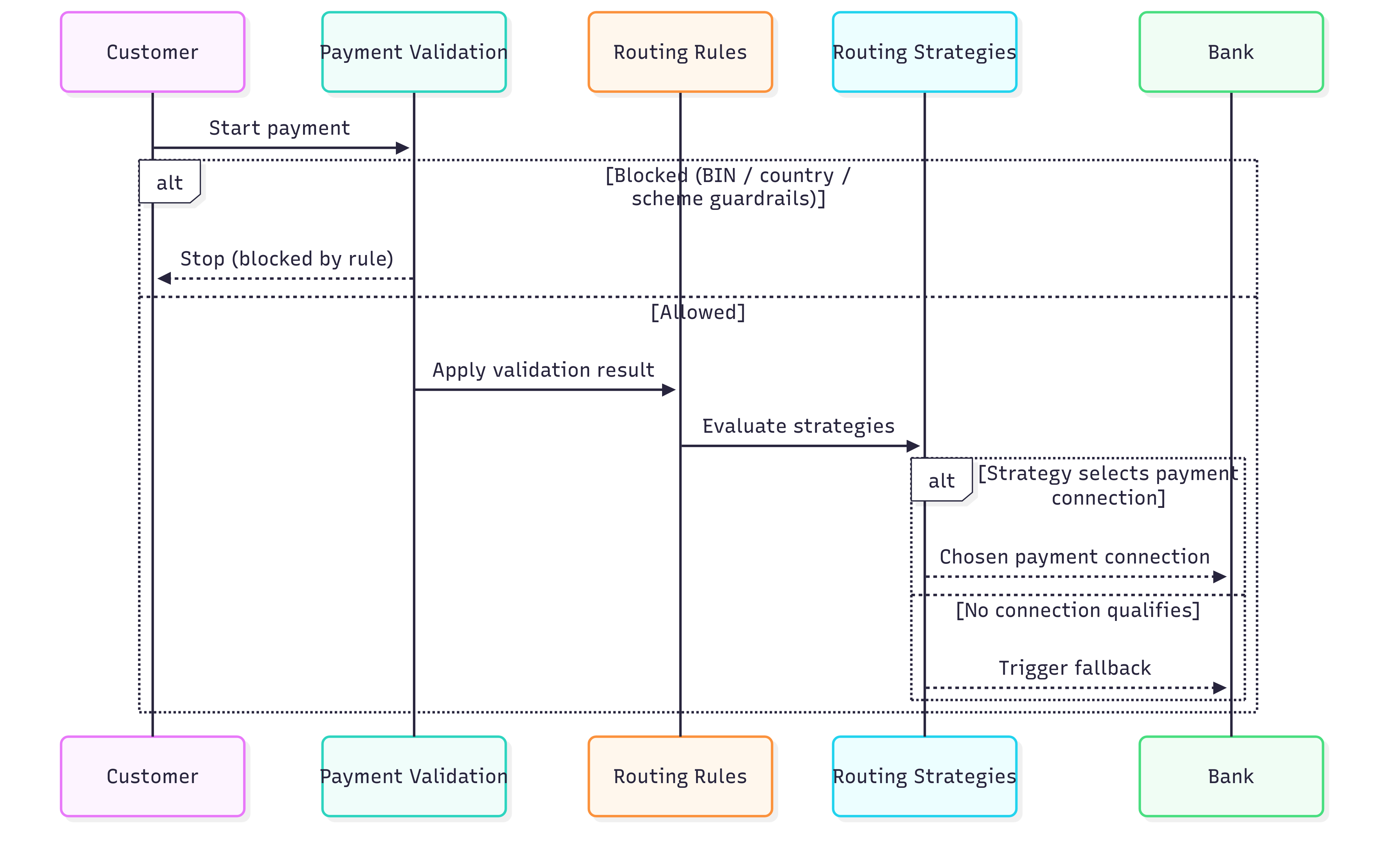
Ottu Router runs each payment through four clear stages:
Payment → Blockers → Routing Rules → Routing Strategies → (Chosen Payment Connection | Fallback) → Processor
- Blockers: Guardrails that can stop a payment outright
- Blocks or allows transactions by card BIN range
- Controls transactions by issuing country
- Filters by card network (e.g., Visa, Mastercard)
- Routing Rules: Decide which payment connections to route the payment through
- Routes by BIN match
- Routes by issuing country
- Routes by card type (Visa, Mastercard)
- Backup route if no match (fallback)
- Routing Strategies: Pick the best payment connection from the eligible set
- Fallback: If no payment connection qualifies, route to the default connection
The Router always logs its decision: which blockers applied, which connections were eligible, which strategy was used, and why the final connection was chosen.
Blocker Rules
These rules filter transactions before routing begins.
| Blocker | Description |
|---|---|
| BIN Access Control | Allows or blocks transactions based on the card's BIN range |
| Geographic Restriction | Restricts or permits transactions based on card-issuing countries |
| Card Scheme Restriction | Filters transactions by supported card networks such as Visa or Mastercard |
Routing Rules
These rules assign valid transactions to the correct payment connection.
| Rule | Description |
|---|---|
| BIN-Based Routing | Routes a transaction to a specific payment connection based on BIN match |
| Country-Based Routing | Directs transactions to payment connections depending on the card's issuing country |
| Supported Schemes | Routes based on card type like Visa or Mastercard |
| Fallback Routing | Acts as a backup route when no other rule matches |
Routing Strategies
Once the Router finds valid payment connections, selection strategies decide how to pick the best one.
Multi-Selection Strategies
These consider several payment connections and select based on rule logic.
| Strategy | Description |
|---|---|
| Exclude Unavailable | Removes connections with too many recent errors. Can blacklist for hours or until midnight. Automatically expires after a set time |
| Transaction Size | Routes based on transaction value. Each connection can have a minimum and maximum amount |
| Country Based | Routes payments based on card country issuer/acquirer |
| Currency Based | Routes payments based on acquirer payment connection vs card currency |
Single-Selection Strategies
These narrow immediately to one best payment connection.
| Strategy | Description |
|---|---|
| Distribution | Distributes traffic by fixed percentages across connections. Example: KNET1 20%, KNET2 50%, KNET3 30% |
| Success Rate | Picks the connection with the highest recent approval rate |
| Cost-Optimized | Picks the connection with the lowest effective fee |
| Round Robin | Distributes transactions evenly across connections by cycling through gateways |
| Fallback | Acts as a safety net — sends to a default connection if no other options are available |
FAQ
What's Next?
- Payment Gateways — Browse all supported gateways
- Currencies — Multi-currency exchange configuration
- Settings — Configure global settings and webhooks